Commercial vehicle glass across Sydney
For a work vehicle the glass is rarely the expensive part. The expensive part is the day it spends somewhere other than the job, and the driver standing next to it. We replace windscreens and body glass on vans, utes and trucks at the yard, the depot or the site, so the vehicle stays where the work is. The technical job is the same as on a car, but the pressures around it are different: the damage has usually been there longer, the vehicle covers far more kilometres so a chip runs sooner, and trucks are inspected at the roadside in a way private cars generally are not. There is also a legal split most operators are never told about, because a vehicle over 4.5 tonnes is judged against a completely different set of windscreen rules from the van parked next to it.
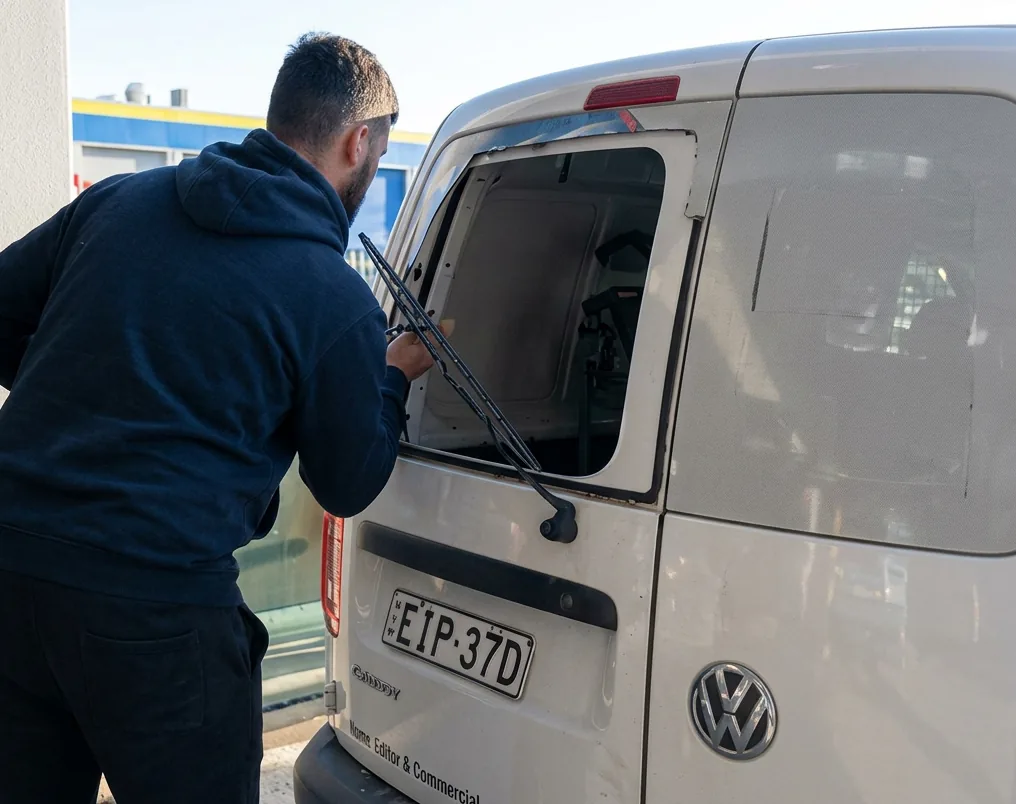
Vans, utes and work vehicles
Most light commercial vehicles are glazed exactly like passenger vehicles: a laminated windscreen bonded with urethane, toughened side and rear glass, and increasingly a camera behind the windscreen driving the same driver assistance systems. Commercial vans in particular now carry driver assistance as standard on many models, and it is the requirement most often forgotten on a work vehicle, because nobody thinks of a van as having it. Where a vehicle has that camera, recalibration is part of the replacement rather than an extra, and the price of the calibration is included in the windscreen replacement. Body glass on vans varies enormously between panel, window and crew variants of the same model, so identifying the exact build matters more here than on a car.
- Laminated windscreens bonded with urethane
- Toughened side, rear and barn door glass
- Original equipment glass fitted as standard
- Panel, window and crew variants identified separately
- Camera recalibration included in the replacement price
- Ready to drive and load when we finish
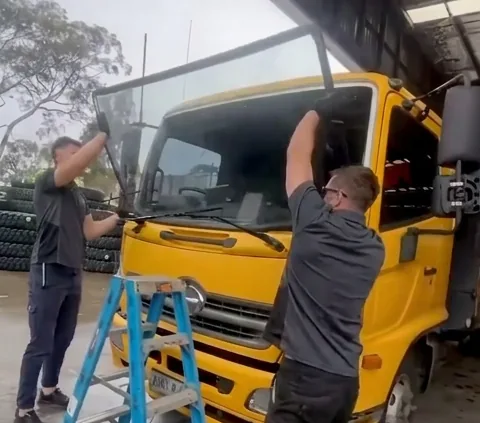
Trucks, and the rules that change over 4.5 tonnes
This is the part almost nobody explains. Gross vehicle mass of 4.5 tonnes is the line. Below it, your vehicle is judged against the NSW light vehicle inspection standards, the same rule that applies to a family car: damage in the area of windscreen in front of the driver, with only two of three defined damage types acceptable there. Above 4.5 tonnes, your vehicle falls under the National Heavy Vehicle Inspection Manual instead, and that document sets out specific limits. In the wiped area in front of and on the same side as the driver, a bulls-eye or star fracture over 16mm across is a reason for rejection, as is a hairline crack over 30mm long, or a crack running from the edge of the windscreen over 75mm long. Damage that scores, sandblasts or discolours that area enough to interfere with the driver's view counts too. Worth knowing if you run a mixed fleet: the ute and the rigid in the same yard are on different rule sets, and a Hino sized truck can sit either side of the line depending on the model.
- 4.5 tonnes GVM is the dividing line
- Over 4.5t: bulls-eye or star fracture over 16mm across
- Over 4.5t: hairline crack over 30mm, or edge crack over 75mm
- Under 4.5t: the NSW light vehicle rule applies instead
- Stone shields are permitted if they do not reduce the driver's view
- Replacement glass carries a standards mark, which is worth checking
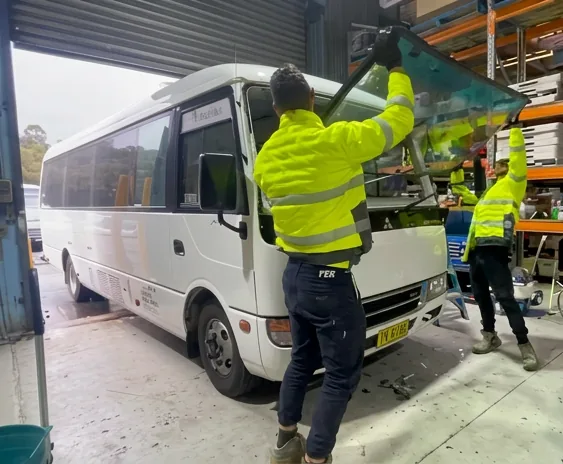
Repairs, replacements and planning the downtime
A chip caught early is the cheapest thing on this page, and we repair damage smaller than a ten cent coin on the passenger side, or a five cent coin directly in front of the driver. But on a truck there is something you need to know before choosing a repair over a replacement: our repair limit is more generous than the heavy vehicle inspection limit, and a resin repair always leaves a visible mark. A repair restores the strength of the glass and stops the damage spreading, but it does not automatically make damage that was already over the limit compliant. If the truck has to pass an inspection, replacement is the safer answer and we will tell you so rather than sell you the smaller job. On timing, a straight windscreen replacement takes about two and a half hours on site, or around three where the vehicle needs its camera recalibrated, and the vehicle is ready to drive and load when we finish rather than standing afterwards. Several vehicles can be attended in the same visit.
- Chips repaired to the coin test, on any vehicle
- A repair does not automatically clear an over limit defect
- Replacement is the safer answer where the truck must pass inspection
- Two and a half hours on site, about three with recalibration
- Several vehicles attended in one visit
- Business accounts and invoicing available
What we work on
Vans, utes and trucks
Up to Hino sized rigid trucks, attended the same way as any other vehicle.
Attended where the vehicle is
Yard, depot or site, so the vehicle is not driven anywhere damaged.
Two different rule sets
Over 4.5 tonnes your windscreen is judged against different limits entirely.
Downtime is the real cost
The job is planned around when the vehicle can actually stand still.
Get a free quote
Tell us the make, model and build year, the body type, and where the vehicle will be parked. Yard, depot, site or roadside all work but they need different things from us, and site access is worth mentioning up front. Give us the GVM if you know it, since it decides which inspection rules apply to your damage. A photo of the damage and a second showing the whole front of the vehicle helps, because commercial windscreens vary far more between body builds than passenger vehicles do and a model name alone often does not identify the glass. If more than one vehicle needs attention, say how many and where they are.
Service available across every Sydney region
Central and Inner Sydney
Sydney CBD, Circular Quay, The Rocks, Surry Hills, Darlinghurst, Kings Cross, Newtown, Marrickville, Enmore, Alexandria and Waterloo
The East and Northern Beaches
Bondi, Coogee, Maroubra, Manly, Dee Why and Narrabeen
North Shore and Northern Suburbs
Mosman, Chatswood, North Sydney and the Hills District including Baulkham Hills
South and West Sydney
Cronulla, Hurstville, Brighton Le Sands, Parramatta, Penrith, Campbelltown and Camden
Frequently asked questions
Do you come to our yard or site, or does the vehicle have to be brought somewhere?
We come to the vehicle. That is the point of a mobile service and it matters more on a work vehicle than on a car, because the alternative is a driver spending half a day delivering and collecting it. What we need is somewhere dry and sheltered enough for the adhesive to bond properly, and room to work around the front of the vehicle. There is no callout fee anywhere we work. Tell us about site access when you book.
How long is the vehicle off the road?
A straight windscreen replacement is about two and a half hours on site, or around three hours where the vehicle carries a camera behind the glass and needs recalibrating. The vehicle is ready to drive and load when we finish, because we stay with it through the adhesive cure rather than handing it back and asking you to wait. A chip repair is about half an hour. Planning the job around a period the vehicle is standing anyway is what keeps the real downtime close to zero.
Will a cracked windscreen put our truck out of service at inspection?
It can, and which limits apply depends on the weight of the vehicle. Over 4.5 tonnes gross vehicle mass, the National Heavy Vehicle Inspection Manual sets specific limits for the wiped area in front of the driver: a bulls-eye or star fracture over 16mm across, a hairline crack over 30mm long, or a crack from the edge of the windscreen over 75mm long are each grounds for rejection. Under 4.5 tonnes, the NSW light vehicle standards apply instead, and those permit only two of three defined damage types in the area in front of the driver. Trucks are inspected at the roadside considerably more often than private cars, so damage ignored for months tends to get found.
If we repair the chip, does that make the truck compliant again?
Not automatically, and this is worth being clear about before you choose. A resin repair restores the strength of the glass and stops the damage spreading, which is genuinely valuable, but it leaves a visible mark. The limits above describe damage in the driver's vision area, and a repair does not erase it. On a truck that has to pass an inspection, replacement is the safer answer. We will tell you which situation you are in rather than quietly taking the smaller job.
Do commercial vans need ADAS calibration too?
Many now do, and it is the requirement most often overlooked on a work vehicle. Driver assistance systems reading through a camera behind the windscreen are standard on a lot of current commercial vans, and replacing the glass means that camera has to be recalibrated exactly as it would on a passenger car. We perform dynamic calibration, which is a controlled road drive with a scan tool connected, and it is included in the price of the replacement. Where a manufacturer specifies static calibration, which needs workshop conditions we cannot reproduce at a yard, we will tell you and recommend the vehicle goes to the dealership for that part.
Can you look after several vehicles in one visit?
Yes. What decides it is how many, what they are and where they are parked, since each vehicle needs its own glass on the service vehicle and its own working time on site. Tell us the count and the models when you book and we will plan the visit around it. We offer business accounts and invoicing rather than payment on the day for each vehicle.
How quickly can you get to us?
Usually one to three days, and the deciding factor is the glass rather than the queue. Where we hold the glass for a common vehicle we can often attend the next business day. Where it has to be ordered in, which is more likely on commercial body builds because the glass varies so much between variants, allow three days. Send the build details when you book and we will tell you which of the two you are looking at.
What hours do you work?
Monday to Saturday, 7am to 5pm. We do not attend outside those hours, so a job on a vehicle that only stands still overnight needs planning around a working day rather than fitting into the gap.
Ready to get started?
Get a fast, free quote, or call now and speak to someone who can help.